Joint issues are more common than you think!

【Dr. Nancy’s Vet Class is in Session!】
Today’s Topic: #Pet Joint Issues
More common than you think!
With 50 years of professional experience, Singen Pharmaceutical
is dedicated to providing pets with a healthy life and improved quality of living.
We regularly release important and easy-to-understand educational articles.
Follow us now so you don't miss out on these helpful tips!
We’ve prepared the following topics today—scroll down to find what you need!
1.【The "Uncle Sit": Why so cute yet concerning?】
2.【Why do joint problems happen?】
3.【It’s not Calcium—it’s Joint Support!】
4.【How to support joint health?】
5.【Breeds prone to joint issues】
6.【Shop Singen Products Here】
Introduction:
Joint care is the #1 priority for pet owners in Taiwan.
We often experience joint pain ourselves,
and if we put ourselves in our pets' paws,
we can understand how much strain those tiny bodies endure.
That is why joint maintenance is a vital key!
Maintaining joint lubrication and good habits daily will lead to long-term benefits.

1.【The "Uncle Sit": Why so cute yet concerning?】
Many adorable, human-like sitting poses of pets go viral online.
While we marvel at how cute they look,
linking back to today’s topic on "Joint Issues,"
Singen’s professional veterinarian, Dr. Nancy, explains:
These "Uncle Sit" behaviors can sometimes be attributed to joint pain.

Think of it like a human with poor posture causing back pain;
they will maintain or even further twist their sitting position to find comfort.
This leads to inflammation and swelling, causing a long-term burden on the joints.

< More signs of pet joint pain >
Dogs:
Dogs are more expressive than cats. You can think of them like children seeking comfort; their reactions include:
< Significant decrease in activity >
Consider the impact of weather changes. Obesity puts a greater strain on joints.
Pain + Inactivity = Weight Gain.
Pet owners, please don't just "spoil" them with high-calorie snacks!
< Reluctance to use the bathroom >
Difficulty in positioning may lead to bathroom avoidance, potentially causing urinary tract issues.
< Changes in gait >
Walking differently than usual, such as wiggling the hips or limping.
< Frequent licking of paws and joints >
They try to soothe themselves while hoping their owner notices the abnormality. This can also be a sign of anxiety.

Cats:
As many cat owners know, cats are masters at hiding their emotions.
By the time they show symptoms, it is often already quite serious.
< Difficulty jumping >
Normally agile cats love to climb. If you notice they are no longer willing to go to high places, please pay attention.
< Changes in temperament or behavior >
People often think cats are just moody, but as the one who spends every day with them, you know them best. Any small change is worth noting.
< Staying in one spot for a long time >
Curious cats usually move around. Staying still for long periods is a way to hide vulnerability from "enemies" and minimize pain.
2.【Why do joint problems happen?】
According to international statistics:
20% of dogs over age one,
30% of cats over age six,
And up to 90% of cats over twelve will suffer from degenerative arthritis!
Primary causes include:
Obesity, overuse, improper use, and old injuries.
"Improper use" can be the hardest to understand.
While paw pads provide cushioning, overly slippery floors or environments prone to falls lead to joint wear and tear.
3.【It’s not Calcium—it’s Joint Support!】
Many owners mistakenly think joint care means more calcium. This is actually a myth!
Calcium primarily supports bone strength and density.
The junction between bones is the joint,
where synovial fluid acts as the crucial cushion.
Hereditary hip dysplasia is often overlooked.
If you have concerns, discuss with your vet if this might be the cause.
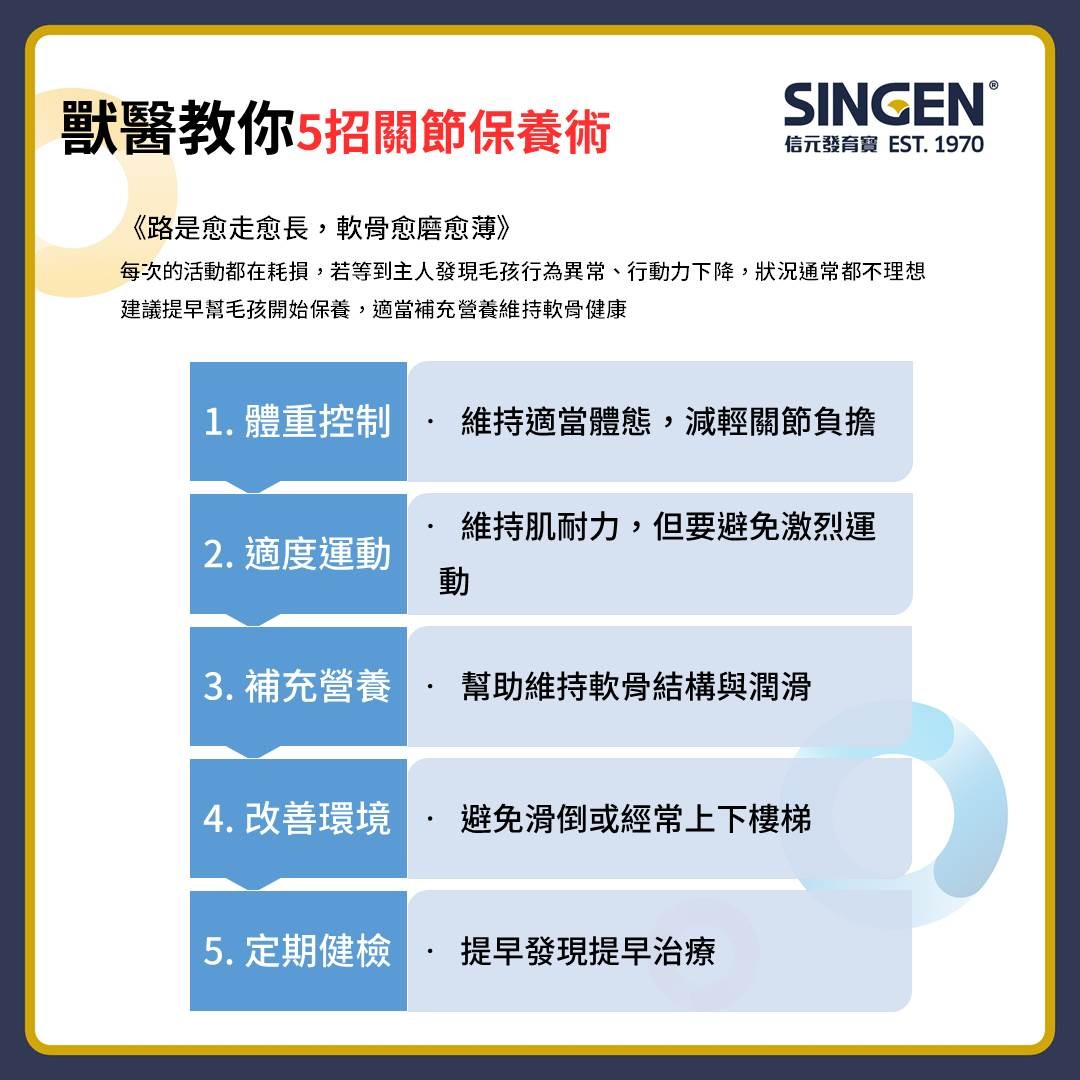
4.【How to support joint health?】
Let Dr. Nancy explain:
Joint cartilage is like a building; it needs both "rebar and concrete" to stay stable. You can help through these common ingredients:
< Green-Lipped Mussel >
A natural superfood rich in antioxidant fatty acids,
similar to the Omega-3s found in fish oil.
It helps regulate the body’s protective mechanisms, improving mobility and maintaining muscle mass to protect joints.
< MSM >
Methylsulfonylmethane helps the body form new joint and muscle tissue.
It reduces muscle damage and pressure, improving mobility by releasing excess fluids that cause swelling and tenderness.
< Glucosamine, Chondroitin, Collagen >
These serve as sources for synovial fluid and strengthen cartilage structure.
When joints are lubricated and supported, bones won't "clash" against each other.
5.【Breeds prone to joint issues】
Dachshunds and Corgis (long bodies, low clearance),
Labradors, Golden Retrievers, and Giant Poodles (large breeds),
Shiba Inus, Bulldogs, Pugs, and Scottish Folds (breeds prone to hereditary issues).
6.【Shop Singen Products Here】
Highly absorbable liquid formula concentrated with essential nutrients.
Simply drop into food. Includes L-Carnitine for weight management.
< Joint Support Nutritional Paste >
High palatability and interactive feeding makes health care fun.
< Joint Care Formula (Powder) >
Easy to sprinkle over kibble for quick daily feeding.
Reference Article: WuoWuo - "The Enemy of Senior Pets: Degenerative Arthritis"
Editor’s Note: WuoWuo is a great voice for animal welfare with many quality articles. Recommended for all pet owners!